Thursday, November 24, 2016

108 Days of Practice Wrap-up

And so...

...my "108 Days of Practice" adventure has finally come to the same end as Monty Python's Norwegian Blue parrot, which:


Has passed on 
Is no more
Has ceased to be 
Gone on to meet its maker 
Bereft of life 
Pushing up the daisies 
Metabolic processes are now history 
It's off the twig 
Kicked the bucket 
Shuffled off it's mortal coil, run down the curtain and joined the bleeding' choir invisible!


To be honest, it has been dead for quite some time, having been nailed to the perch so to speak.  


Looking back, I learned some great Duck Dunn tunes, along with a few others.  Also got to put some honest practice time on a 5-string bass-- a first for me.  


Looking forward, I will try another practice challenge, but shorter in length and with a partner to keep each other on track.  

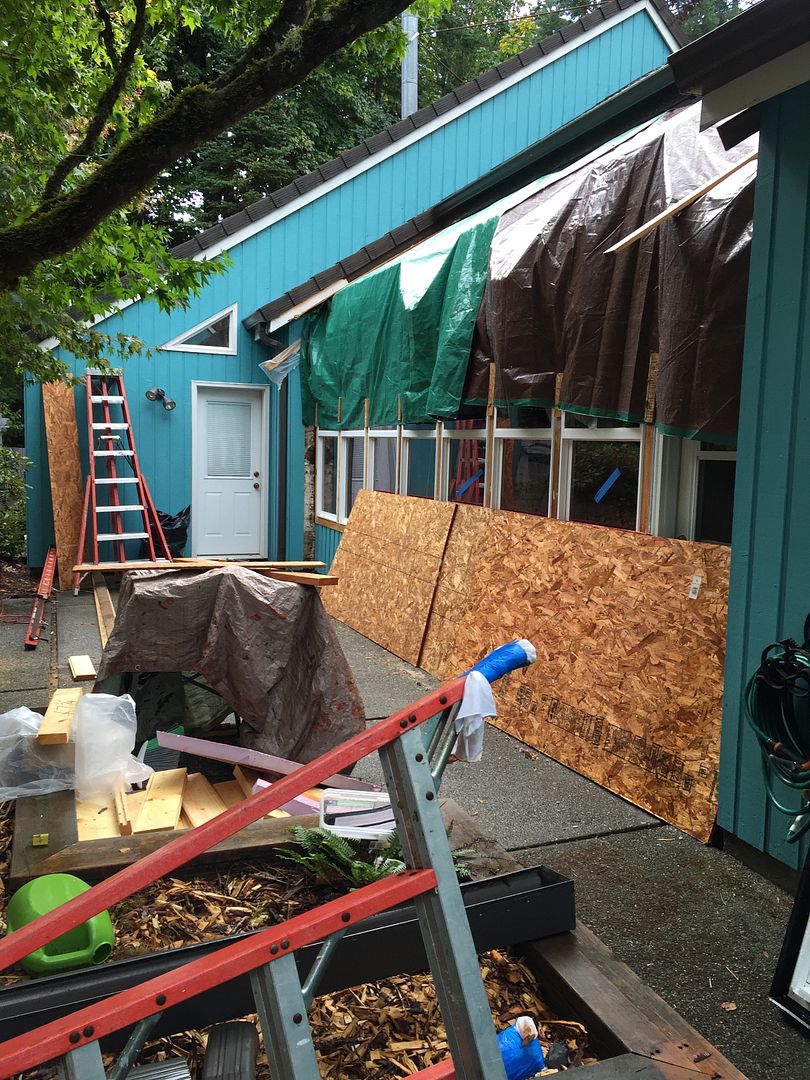
In the meantime, our music-room needs remodeling, along with several other projects around the house, and I still have Sunday service to keep my bass chops up for, so...

...stay tuned, and in tune!


Friday, October 21, 2016

Gear Review: Fender Rumble Version 3

Convenience has become an obstacle in my 108 Days of Practice adventure.  


A great sounding practice rig, and lovely space
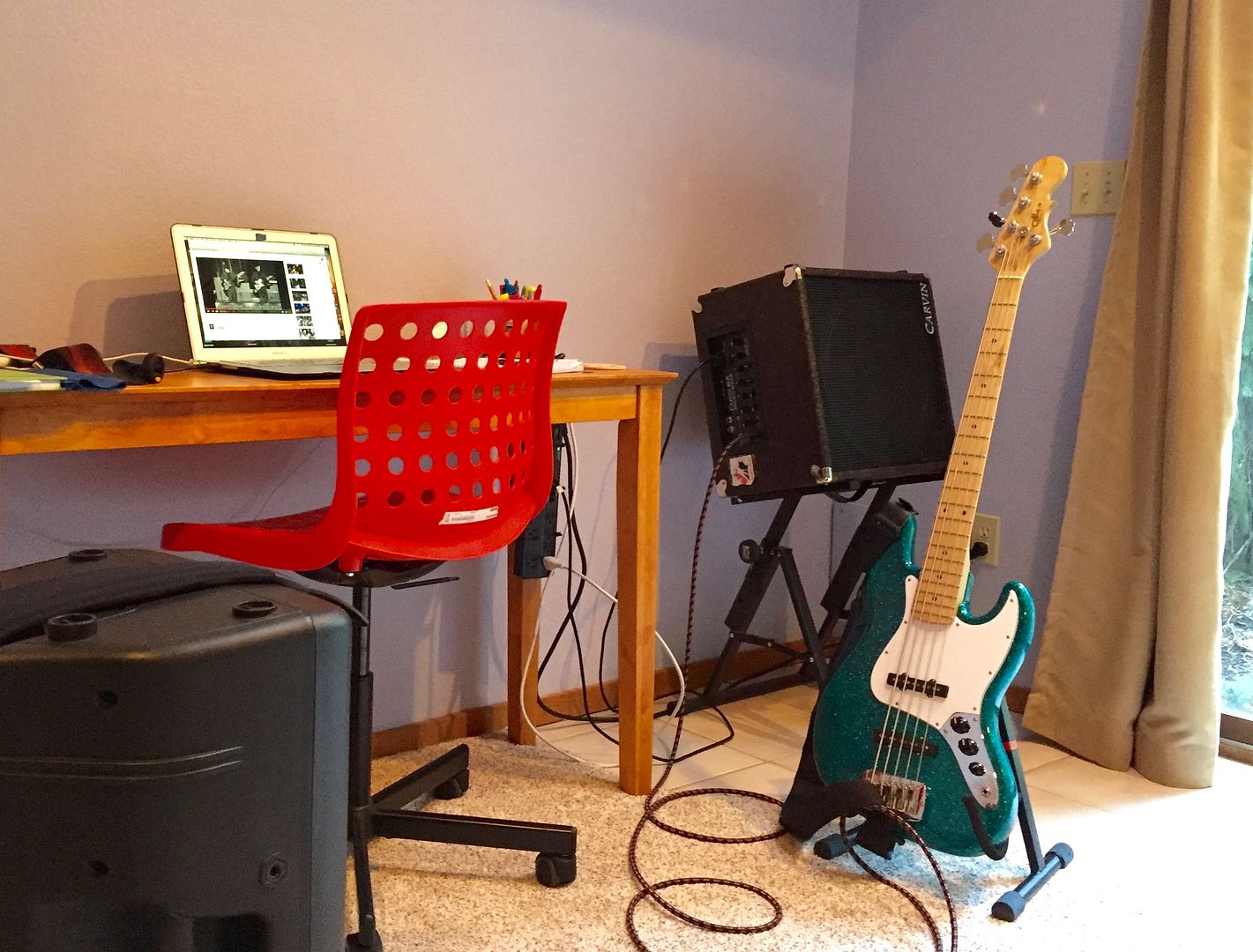
My main practice rig is fairly large; it consists of my main amp, a powered monitor and a Mac laptop.  As such, it remains in my practice room.  It is true, I can move it from room to room, but the setup requires a lot of space-- and frankly, I hate moving the entire rig up and down stairs. 


Boss TU-88 is a great alternative
 for silent practice
My alternative practice rig is much easier to move around, but is limited to playing though headphones.  It consists of a Boss TU-88 Micro Monitor & Tuner, laptop, and headphones.  This is a great setup for playing though headphones, though it is limited to sitting in one spot and using something to keep the light-weight Boss unit in place; stand up to stretch and the unit goes with you...

So what to do?  Use the above excuses as reasons not to practice?  Admittedly, that is exactly what I have done over the last few weeks when skipping practice. Granted, I still got in some good practice sessions, but not quite every day as the project requires... more like every other third day.  

Sweetwater to the rescue!


While taking an honest look at my practice habits last week, I logged on to my favorite on-line retailer to explore items that would address my reasons for skipping practice, thereby enabling me to practice more often.  After an hour or so, I narrowed my search to something that is easy to carry from room to room, with a built in speaker, headphone jack, and auxiliary input; and one rather important feature-- it must be under $100.  All of which pointed to a small practice amp, though most were outside my price range, or starter amps that are just too cheap to bother with.

Then there was one!


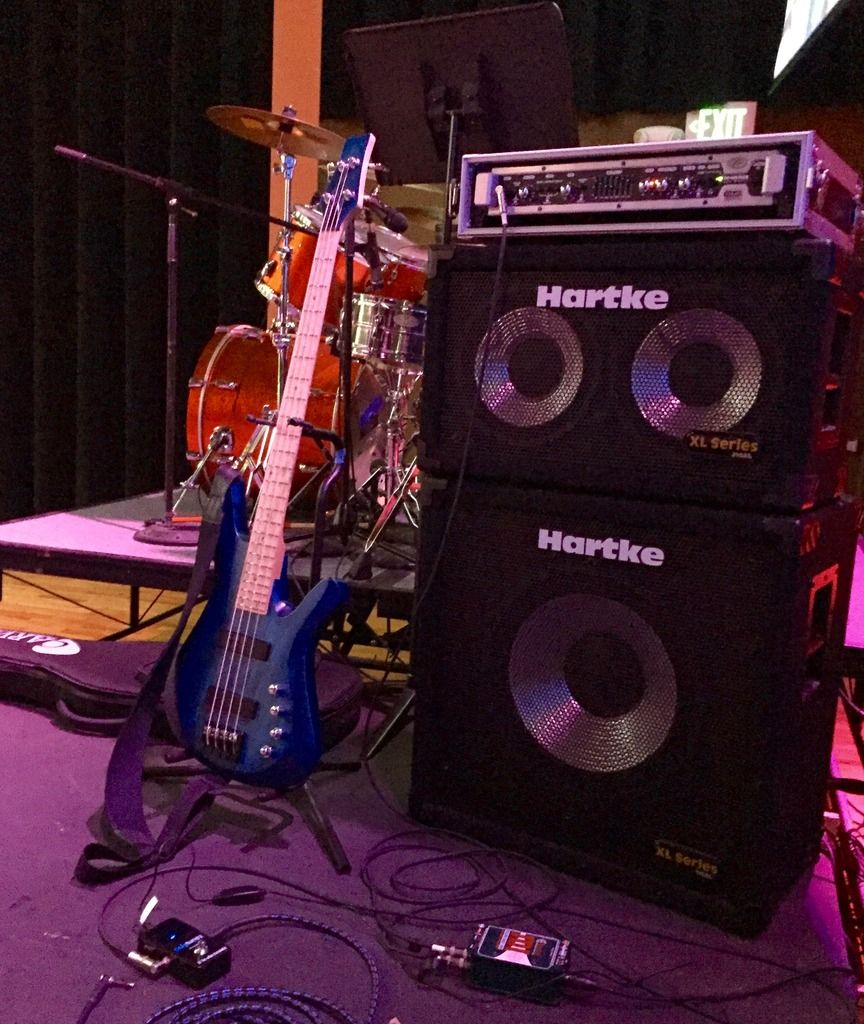
First test-run of the amp with my G&L LB-100
Two actually; Fender's third generation Rumble bass amps in 15 and 25 watts.  The Rumble 25 was only about $20 more expensive than the 15, and considering the 25 was still within my budget I placed my order.  My hope was this little practice amp would be light enough to easily move around the house, heavy enough to remain in place when I want to stand while practicing, handle input from my laptop, or iPhone, and sound good though the speaker or headphones.  Photos of the amp suggest that leaving it in our living room would also be a welcome option as it is very easy on the eyes.  Reviews on-line were overwhelmingly positive, so I had high hopes for this little Chinese made amp.  Five days later it arrived.

Sound Test

As soon as the amp arrived I grabbed my favorite bass and plugged in; mainly to make sure nothing was damaged from shipping.  At first I intended to spend a few minutes going through the controls just to make sure everything was good.  Surprised at how good this little amp sounded, I ended up spending the next two hours playing though this little box of tone.  Part of the initial getting acquainted period was fiddling with the knobs and the two switches.  


Everything I require in a practice amp
Controls are simple: volume, bass, mid, treble.  As is my starting point, I ended up leaving all at their center detent except the volume, which I set to roughly 25%.  The tone is classic Fender, and loud enough to fill our living room.  The two switches (buttons, to be precise)  are "overdrive," and "contour."  The first does what one would expect, which never really appealed to me.  "Contour" seems to scoop out the midrange; again, a feature that I could happily do without. 

Metronome, iPod, headphones, and a great sounding speaker!
Surprisingly, the Rumble's eight-inch speaker sounds much bigger than it is.  Turn the volume up to half and the house is rocking!  This would be a wonderful amp for acoustic jams-- it is very light-weight (about 20 pounds), sounds terrific and can really wail.  This is primarily a practice amp though, and as such it really shines.  The aux input allows for playing along with an iPod, or a metronome as I have been doing a lot lately.  Unlike some practice amps that have trouble reproducing songs from an iPod, this amp handles it with ease.  Add my bass to the mix, and both sounds come out wonderful-- exactly what I was looking for in a practice tool.

Sounds just as good as it looks!
Aesthetically it is a vintage, simple look that either appeals to you or not.  Personally I really like it; more importantly so does my wife, which is a real blessing!   Because she likes it, the amp is welcome to reside in our living room, making it easy for me to plug in without the bother of moving around a lot of gear.  

Since its arrival last week, I have played the heck out of the Rumble.  Will this little wonder of an amp encourage me to practice more often? We will have to wait and see.  In the meantime...

...stay tuned & in tune!


Thursday, October 6, 2016

Gear Review: Carvin Guitars "Ultimate Soft Case"


Those of you who know me, already know that I really don't care for the old hardshell cases.  Soft-cases are far and away my preference.  As a result, I've owned several versions that are on the market today.  


While I've yet to find the "perfect one," I do have a few favorites: the Reunion Blues Continental, and the iGig G525.

Kiesel/Carvin have had their own model on the market for several years; known as the Ultimate Soft Case.  Now that I have a few months of real-world use on mine, I thought I'd share my thoughts here.

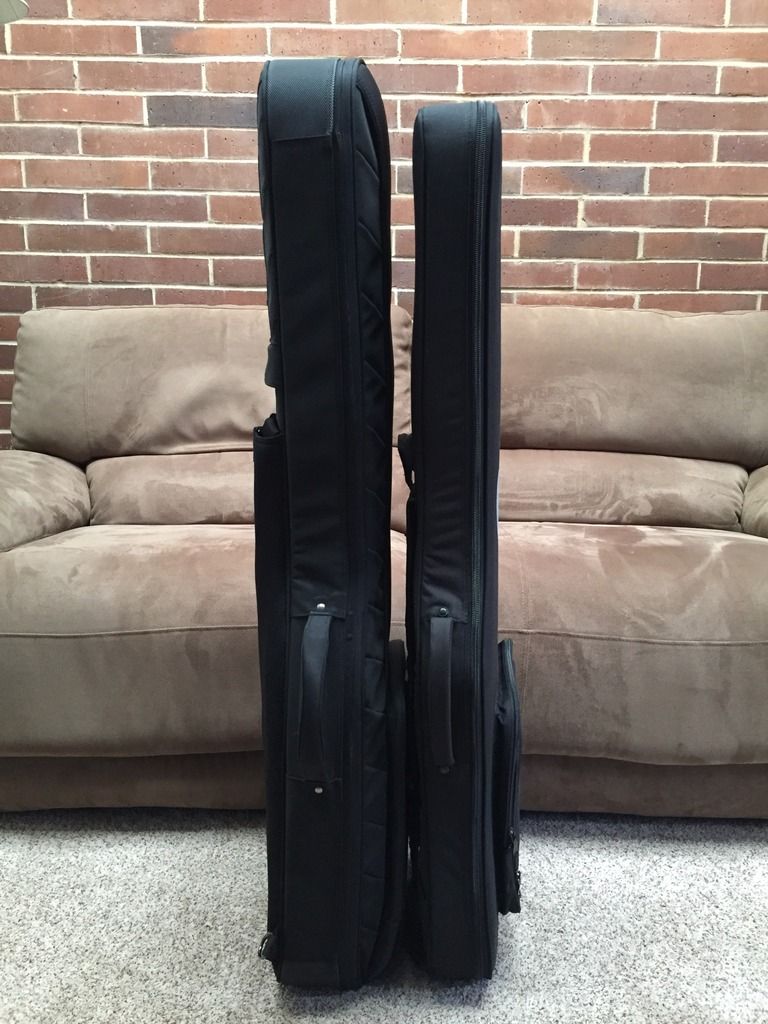
L: RB Continental. R: Carvin USC
To begin with, I really like the Carvin soft case.  Possibly the most notable characteristic of the Ultimate Soft Case (USC) is the relative slim size of the soft case.  Especially compared to the RB Continental.

Next, the second most notable feature of the case is the large "Carvin" label on the front.  The company is predominately Kiesel now, and on 19 September Jeff Kiesel will no longer refer to it as "Kiesel Guitars, Carvin Guitars."  So why the big Carvin logo on the case of a Kiesel bass?  Perhaps this will change as old Carvin stock is phased out for new, Kiesel branded items.  


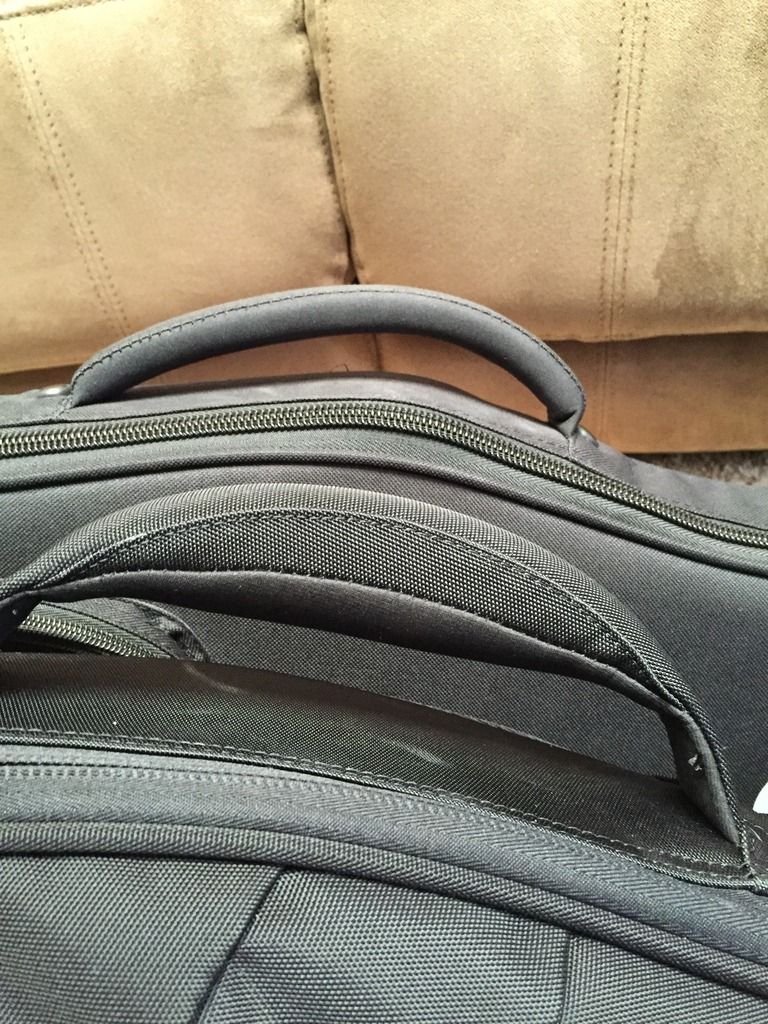
Padded handles are similar between the two, with the Carvin (as it's branded) being significantly smaller than the RB, though far better than most soft-cases which are simply nylon straps.  


Please keep in mind that this is not intended to be a comparison of the two-- I am only using the RB as a point of reference as most bassists are familiar with the RB-- with no intention of declaring one better than the other...

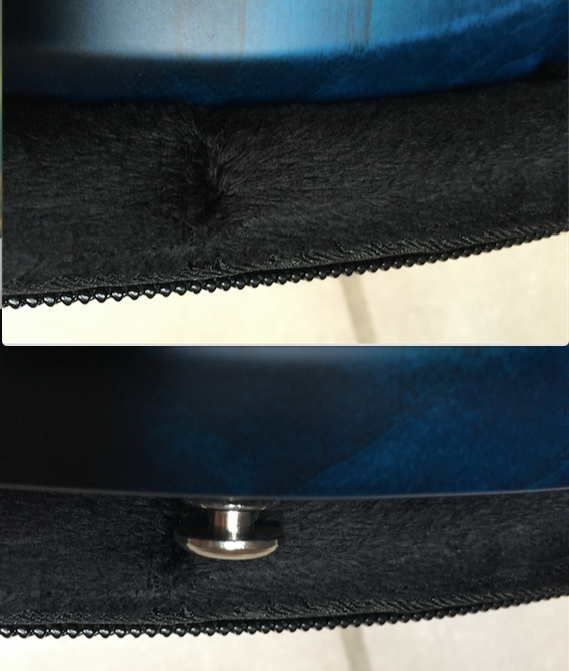
Something that I'm not especially fond of is the limited end-pin protective padding at the bottom of the case.  Kiesel's large, standard endpins-- and more so the Dunlop strap locks-- really work their way into the padding after a month or so.  Granted, they have added a rectangular rubber foot to the outer portion of the cases bottom... which is better than nothing, but not as good as it could be.


I've chosen to deal with this by changing the standard Kiesel end-pin with a smaller, more strap-friendly G&L version that I had in my parts box.  Must say however, kudos to Kiesel for improving the quality of the screw used to secure their end-pin.  In days past it was a very small, flimsy little thing; now it's a screw slightly larger than that which accompanies the Dunlop strap locks, or G&L.

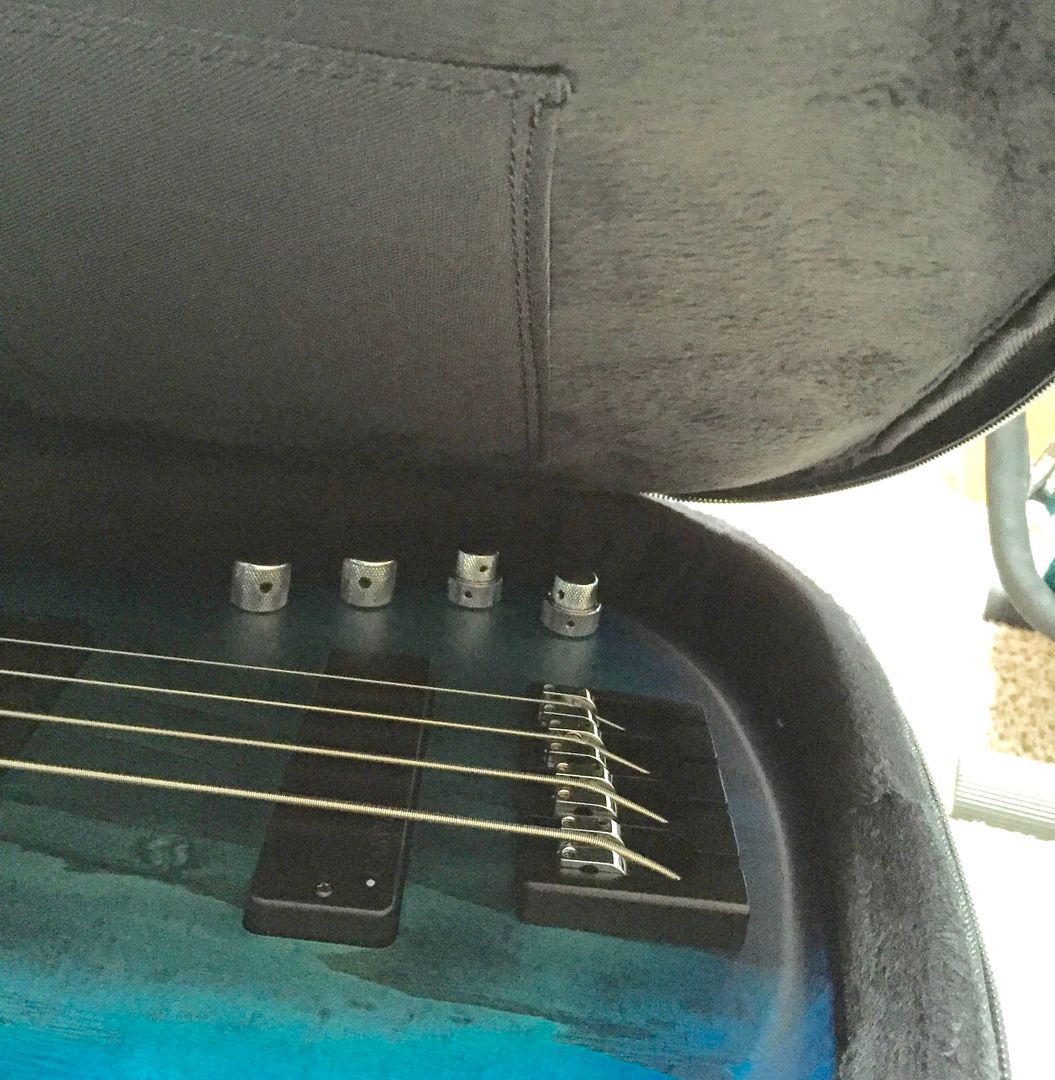
 Something that left me scratching my head is the placement of the nylon patch found on the lower interior, intended to protect the case from sharp portions of the instruments bridge.  It comes nowhere near the bridge.  Looking photos posted by others reveals the same thing-- it's useless for just about every instrument intended to fit this case.  To overcome this, I rest a polishing cloth over the bridge.  Doing so not only protects the case, but reminds me to wipe the bass down before stowing it. 

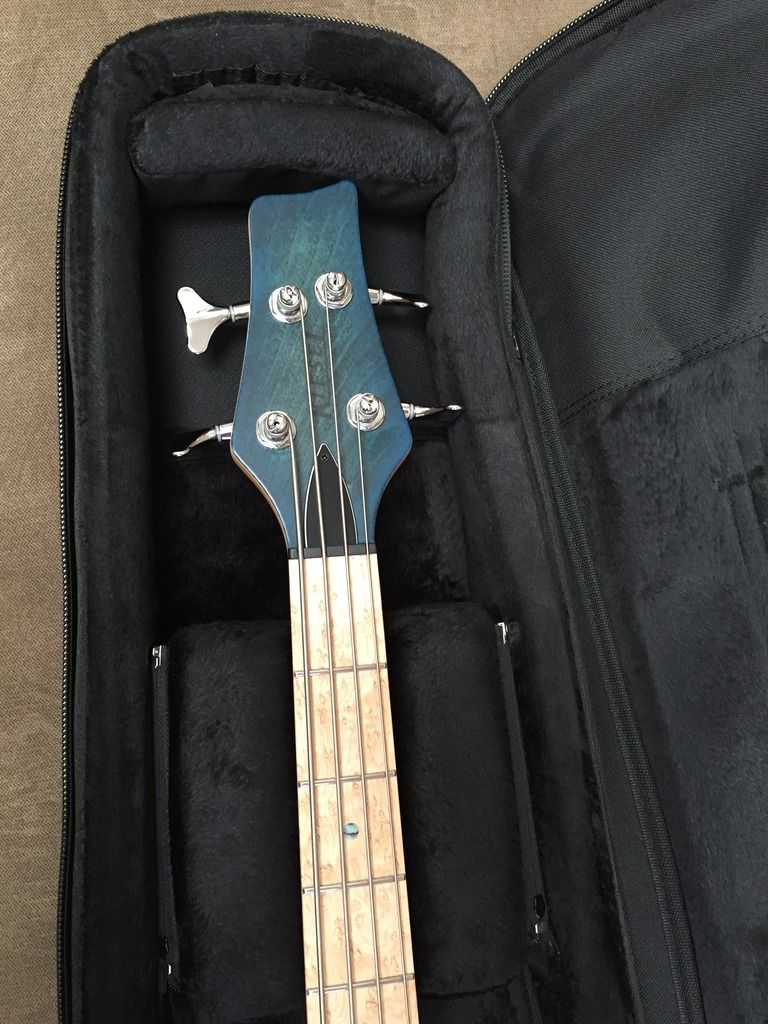
Protection for the headstock is excellent!  Not only is the neck supported by a pillow that also keeps the neck positioned properly, but there is an extra section of thick padding at the top, should the top of the case impact something when carried by its handle; something I've done on several occasions when my hands are full trying to squeeze past people congregating near a doorway.


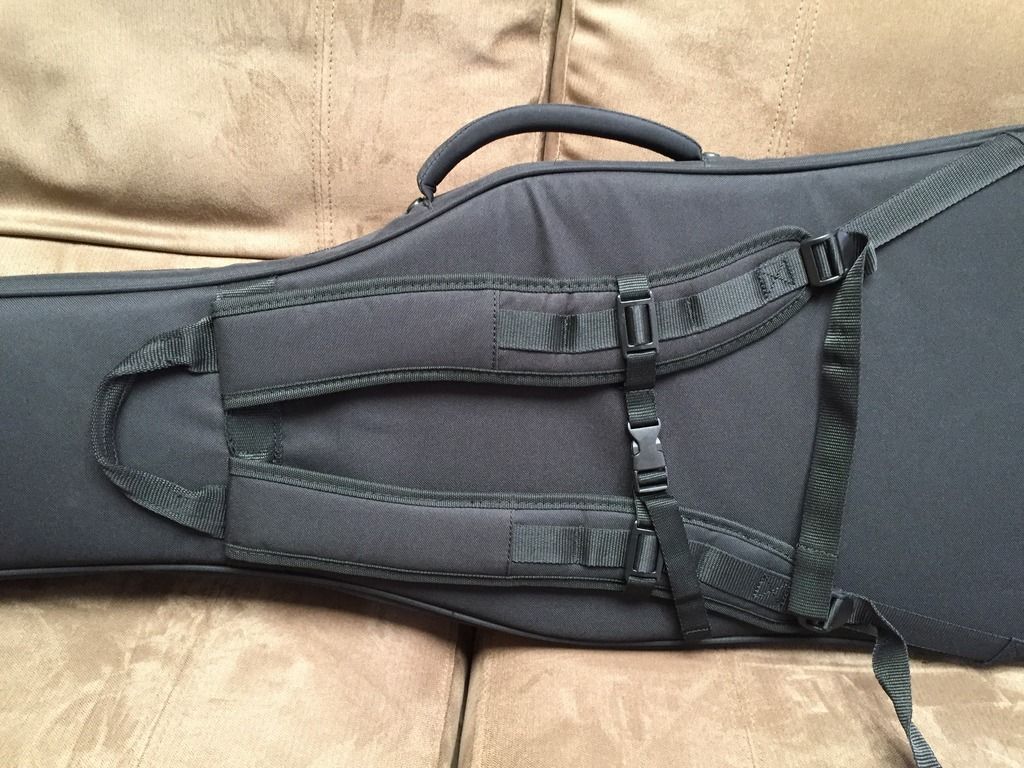
Finally, the shoulder straps on the back can be secured nicely by tightening up the ends as well as a chest strap.  This makes the straps less likely to snag on something when loading/unloading, or when walking through crowded areas such as a subway station, or after a church service.

Overall, it's a great case.  Not perfect, but again I have yet to find that one.  Is it better than the G&G hard case?  Well, that's a matter of preference, but I believe it is far superior in most situations.  


That's not to say the G&G is a bad case-- it's among the best available for those who like hard cases.  Kiesel has updated them slightly as well; the old style raised metal logo historically fixed to the face of the case has been replaced by a Kiesel Guitars badge underneath the handle.  A classy touch.


The Ultimate Soft Case is going to be my choice for all future Kiesel builds, however that big, bold "Carvin" logo would keep me from buying one for a non-Kiesel basses.  That may be overly OCD of me, which is okay-- I've got several other soft cases to protect those basses.

For my review of the Vanquish bass that came with this case, check out the post, "Kiesel Guitars Vanquish V49K."

Stay tuned & in tune!


Wednesday, September 28, 2016

108 Days of Practice: 10 Weeks In...

Excuses, excuses...
As I've written about before, it's been really tough to practice on a daily basis and there have been spells of non-practice.  

Such as it was during the last few weeks.  We are in the middle of a remodeling project on our home, and it has consumed most of my time.

The time I did spend practicing were mostly in preparation for our Sunday morning worship the last few weekends.  Two weeks ago I took along my new G&L 5-string for its first time on stage.  Having used it in my practice sessions prior to that Sunday, I was feeling pretty comfortable with that additional string and significantly wider neck.  It turned out that I wasn't quite ready.  
A's become E's... practice, practice, practice
Being a visual learner, that 5th string kept tripping me up.  This problem was not about me actually looking at the fingerboard, rather I have a mental image of the fingerboard and that guides where my fingers rest.  There were several times I was thinking "A" (5th fret, E-string) but ended up playing the "E" on the B-string.  That disconnect between my brain and fingers continued throughout our set, but not enough to be a distraction.  It was however, enough for me to sideline the hotrod 5-string for a while longer-- just until I can reprogram my mental visualization to include separate "maps" for each type of bass.  

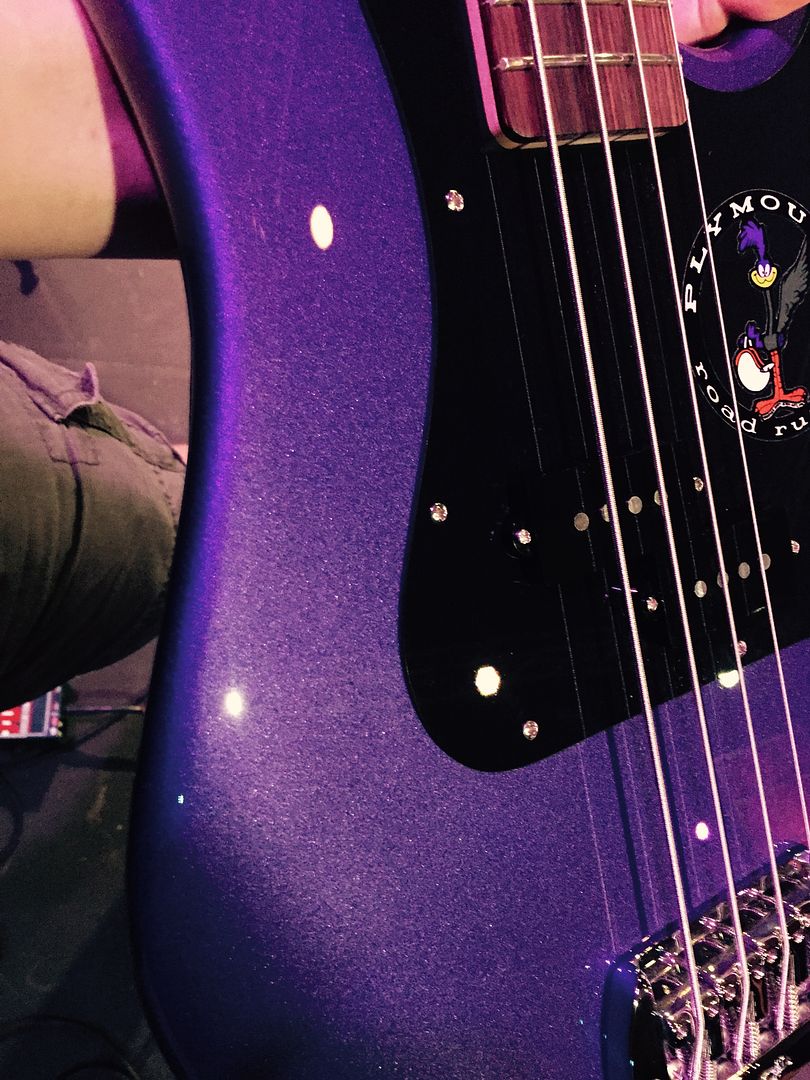
Sunday morning rehearsal with the Roadrunner
For last Sunday's worship set I used my Plum-Crazy G&L LB-100, which is a P-bass type four-string.  Having missed several days of practice-- including our weekday rehearsal due to the work on our house-- I was far less prepared than usual, so having a four-string that I'm comfortable on was exactly what I needed.  Unlike the week before, I could now focus my attention on making music and timing.  Now, I still enjoy my five-string-- I just need to spend a little more time with it before bringing it out again on Sunday morning.  
My Plum Crazy G&L Roadrunner
Last time I mentioned that Queen had been on my radio quite a bit lately, and that I wanted to add a few of their songs to my repertoire.  Because their 1980 classic "Dragon Attach" had been stuck in my head for days, I squeezed some practice time into my schedule to work on the song.  So far I have down the main riff and the baseline during the guitar solo.  The bass solo is very close to the main riff, so I'm not far from having it down.

Duck Dunn remains at the top of my practice routine.  Having the notes of Green Onions down, I have since been working on his approach to the song.  Listen to the recording, then the 1962 live version and you will notice there is more "bounce" to the live version.  That bounce is still there in the recording, but less noticeable.   There is also an interesting timing which I noticed missing in my playing, though I am getting better at it as I keep chipping away at the tune.

Moving forward with my 108 Days of Practice, I am going to try changing my approach a bit.  In a recent Q&A video with Jeff Kiesel (the first from Kiesel's new factory), Jeff mentions that  Greg Howe suggests practicing for shorter times, and more often, opposed to long practice sessions once or twice a week.  For example, 15-minutes in the morning, 15-minutes in the afternoon, and another 15-minutes in the evening.  By adopting this to those days where I am busier than normal, my hope is that I will be able to be more consistent with my daily practicing.  To find out if this approach works for me...

...stay tuned & in tune!


Thursday, September 22, 2016

Gear Review: Kiesel Guitars Vanquish V49K

In late 2013/early 2014, Jeff Kiesel of Carvin Guitars (now Kiesel Guitars) released photos of a prototype instrument that would later become a production model called the, "Vanquish Bass" in April 2014.
Prototype Vanquish Bass
Fast forward two years; April 2016, I was finally in a position to place my order for my very own Vanquish-- a graduation gift from my loving wife as I was wrapping up my masters degree.  Happy day!!

Five-weeks later it arrived, thanks to my salesperson's special effort to get the instrument to me in time for graduation. 


Here are the specs I ordered:
- Light-weight ash body
- Antique ash treatment
- Satin/matt finish

- Aqua (non-burst) finish

- Matching headstock
- Maple neck

- Birdseye maple fingerboard
- Abalone dot inlays
- Luminlay side-dots

- Stainless steel frets
- Black Kiesel logo
- Dunlop Straplocks

- .45 Dunlop Strings
- Ultimate Soft Case

It was a beautiful day when the bass was derived by FedEx, so I decided to take the  shipping box outside for the official un-boxing.  

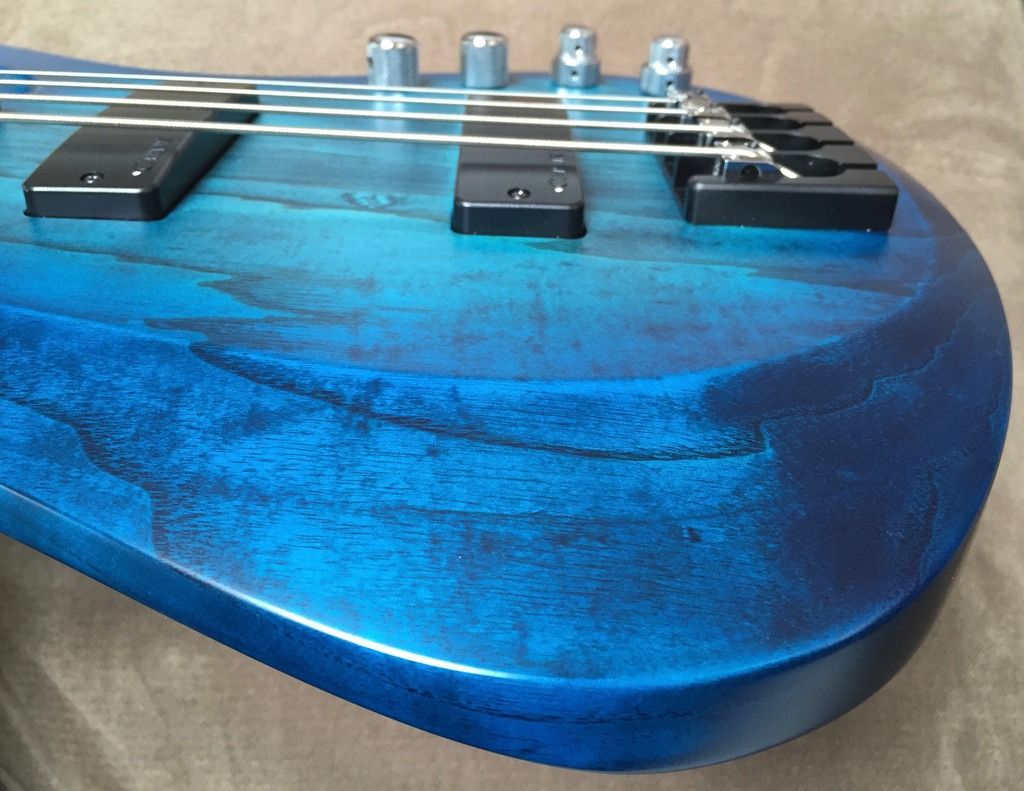
In the mid-day sun the bass first looked to have the requested aqua non-burst finish.  However, when I brought it inside the finish is clearly an aqua-burst.  During the 10-day trial I really struggled with the decision whether or not to send it back for a rebuild in the full aqua finish.  After spending time playing it, I realized I could not let this one go-- it really is an amazing instrument!


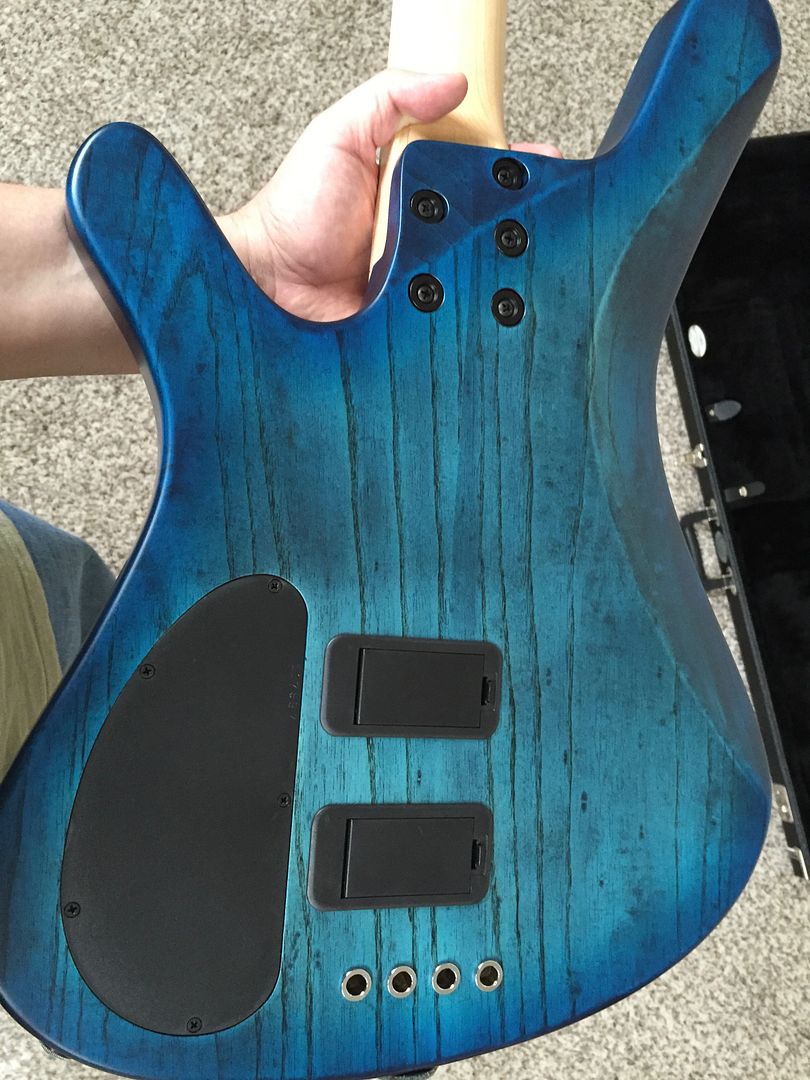
Sometimes color transitions in burst finishes are abrupt, which is not the case with this one; the colors seem to flow together seamlessly.  Underneath the aqua-burst is a treatment to the body wood Kiesel calls "Antique Ash Treatment."  Not to be confused with a distressed "relic" treatment such as those offered by Fender, it is a staining process that enhances the natural grain pattern which gives the wood grain an older ("antique") appearance. 

A few updates to the model were instituted between the time it was released and when mine was built-- the most obvious being the neck heal.  Its old four-bolt neck plate has been replaced by five countersunk bolts on a beveled neck heal-- much like Kiesel's new "Aries" model guitar.  This particular update included an official switch of the bass's Carvin designation to Kiesel; a move that has been fairly common in their catalog during the guitar companies transition back to its original name.  A non-visible update is the inclusion of dual carbon fiber reinforcing rods in the neck.  

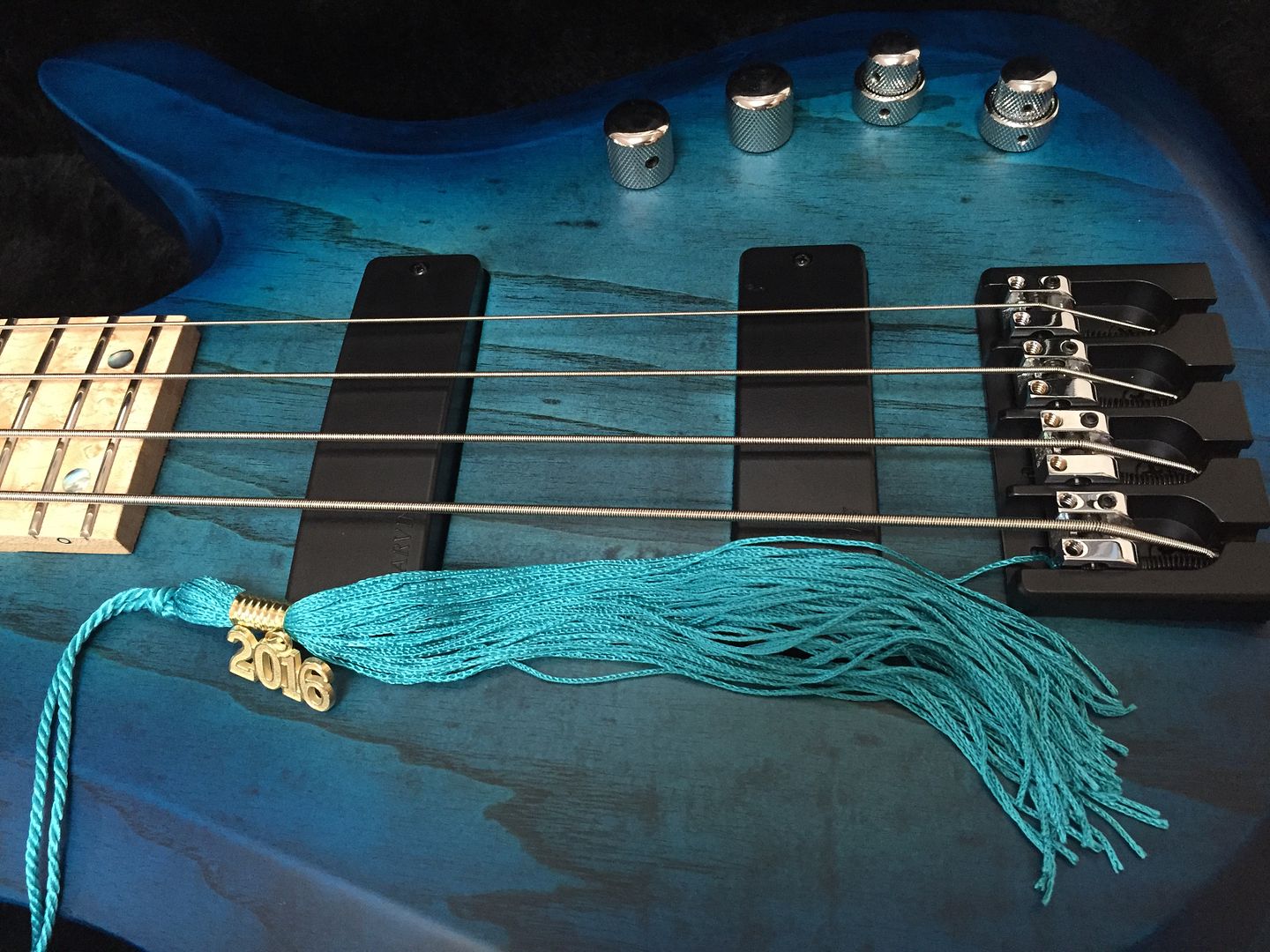
2016 Master of Public Administration graduate!
Admiring the aqua-burst finish and grain pattern in the bass is one thing; playing the bass is another-- and this one is a joy to play.  Its light-weight ash body is just heavy enough to offset the neck so it balances very nicely when playing it resting on my leg.  On the strap it sits right where I set it without any neck-dive.  This feature alone is a welcome improvement over some of my other favorite basses.  Reading about the pickups radiused profile to match the 14" fingerboard at first seemed like just another marketing jingle.  However, these really do make finger-style playing more comfortable as each string sits an equal distance above the pickup.  It is a feature that I wish more pickup manufactures would use; you don't know what your missing until you play one with radiused pickups.

Tone report:
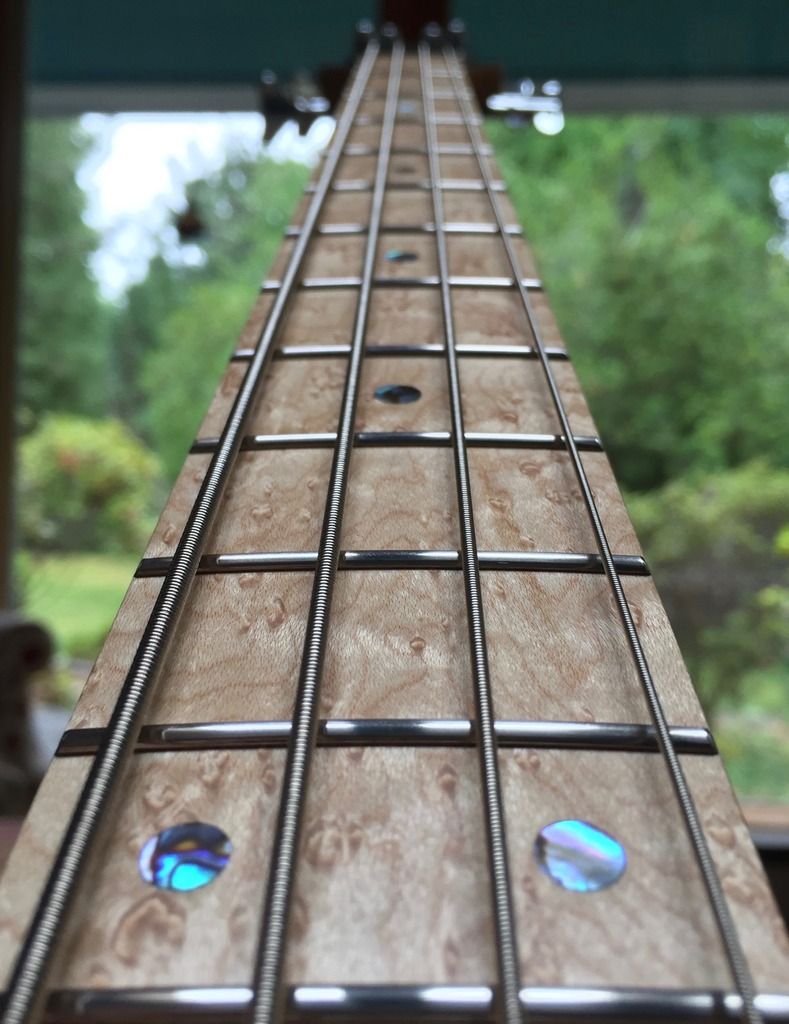
Birdseye maple with abalone 
Tone is such a subjective thing, I won't spend a lot of effort describing it.  Pickups are humbuckers and the electronics are 18-volt active.  It does include passive mode capability by pulling up on the volume knob.  Because I prefer to keep things simple, active basses never much appealed to me.  This bass again changed my perspective about active electronics.  Its preamp is very useable even for a simple guy like myself.  Other than the volume, each knob has a position detent that I really like on active basses.  


In action a week after delivery
Usually on basses with two pickups, I rarely (almost never) use the bridge pickup on its own.  This is the first bass with a bridge pickup I like on its own; it retains enough bottom end that I expect to hear from a bass along with added tremble that makes it sound unique from the neck pickup.  Together the pickups have the growl of a Jazz, with the wider fullness of humbuckers.  In cases where the neck pickup alone sounds too big, the blend knob actually works to balance things out-- this has become my favorite setting.  Another important thing about the pickups is that the volume level remains the same in both active and passive mode.  My only complaint with passive mode, is that the only controls that work are the volume and blend; treble & bass do not.  This is not a major concern for me since I really enjoy using the preamp on this one.  However, it's always nice having a passive option for emergencies (i.e. dead batteries).


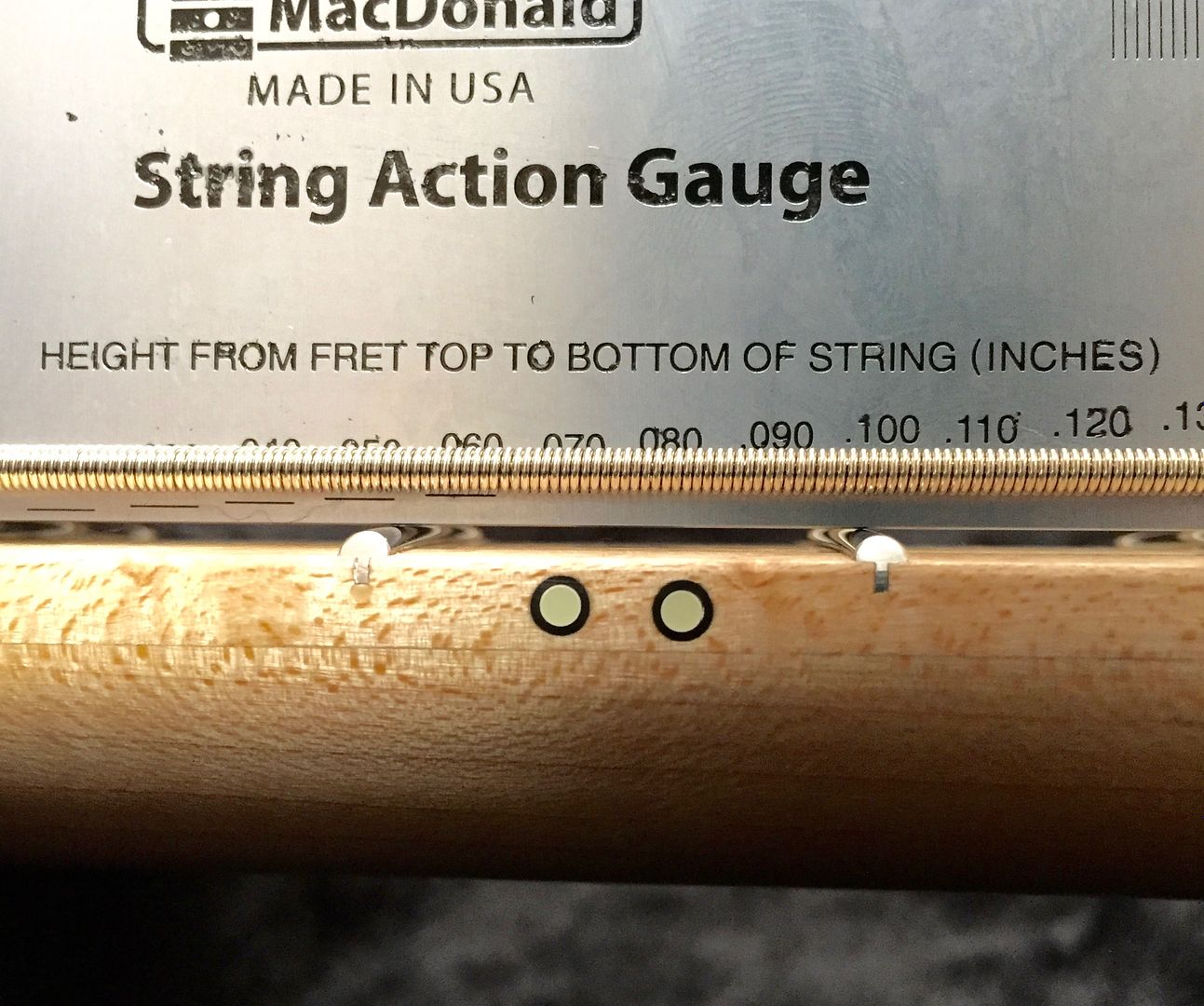
Factory action setting
String action is fantastic! Kiesel is now using Dunlop "Super Bright" strings which I really liked.  Wanting to experiment with other strings, I installed a set of DR "Pure Blues."  Surprisingly the new strings required me to adjust the truss rod a bit.  Surprising because I did not expect there to be much difference in tension between the two sets.  While I enjoy the DRs, I will be installing another set of Dunlop's because they had such a great feel.  Both sets sounded great on the Vanquish.


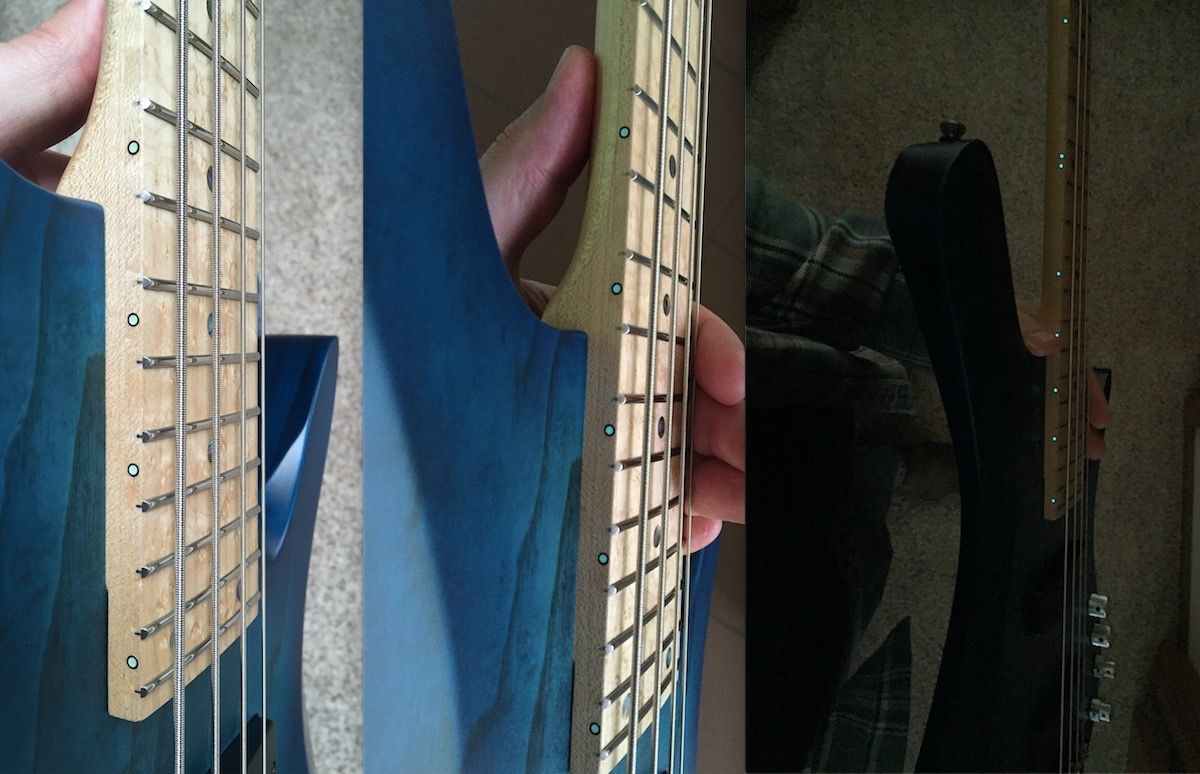
Luminlay in different lighting conditions
Another new option that is a mere $30 upgrade is the Luminlay side-dots.  These are glow in the dark markers that look like average side dots at first glance, but they glow when exposed to sunlight, or light from a cellphone camera.  At first I thought these might be a distraction, but I wanted to leave my comfort zone with this order and thought this would be a fun option.  There was no need for concern because these things are great and far from distracting.  The Luminlay option is something that I will include in all my future orders-- I like them that much.

New case logo
The bass arrived in a newly updated G&G Tolex case with a new Kiesel logo under the handle.  Even though my order specified the Ultimate Soft Case, the more expensive Tolex case is really nice.  After a quick call to my Kiesel salesperson the soft case was on its way to me free of charge.  Customer service at Kiesel is outstanding.  

Now, after several months of playing the Vanquish I have really become spoiled; the satin-finish neck feels great in the hand, the action is really low and without buzzing, fit & finish is outstanding, and its tone-- soooo nice!  Kiesel's Ultimate Soft Case is also a great upgrade to the traditional Tolex case, and since I am very fond of soft cases I wanted to do a separate review of that, so...

...stay tuned & in tune! 


Friday, September 9, 2016

108 Days: Green Onions and Other Tasty Morsels

Song #1 in my "ode to Duck Dunn" study:

Booker T and the M.G.'s are responsible not only for their backing of popular artists such as  Sam & Dave, Otis Redding, Albert King, and Wilson Pickett, but also for their own fantastic records.  Green Onions is one of the most popular R&B instrumentals ever.  

Duck Dunn actually had nothing to do with the writing of the song-- Lewie Sternberg was the original bassist.  However, Dunn was did play the song for many years along with his M.G.'s band mates.  And that is enough for me to include it in my studies.  Here is a great video of the band squeeing all they can from this 12-bar blues: 

Green Onions was the primary focus of my practice sessions for about a week.  By itself, it is pretty straight forward.  In its original record version the tune is a bit shorter-- short of 3-min, compared to the live version (above) at about 4:15. A different, more energetic vibe is present with the live version and as such it changes location of some accent notes.  It was helpful to first learn the recorded version, then with the foundation established learning the live version was much easier.  Again, it is a straight forward bass riff that repeats itself steadily during the course of the song-- and it is GREAT FUN to play!
My new practice space-- I now have a window!
When learning the tune I used the sunburst G&L SB1, though once I had it down I switched to my 5-string G&L JB.  Doing so was mainly to become more comfortable on the 5-string, and with a little tweaking of knobs on the bass and amp, I achieved a tone respectable enough for Green Onions.  

Because I am a visual learner, writing out tabs and notes for the song was a big help.  It also reminded me that learning to sight read music notation is something I need to include in my practice routine.  Tabs are great in conjunction with a recording, and a lot of practice, but music notation provides a visual account of the rhythm and duration of notes-- something I very much want to learn.  

The list of songs I want to dig into is long, and I keep adding to it; I think something from Otis Redding should be next in the queue-- perhaps "the Dock of the Bay... but then there are the Staple Singers, Sam & Dave...

...stay tuned & in tune!


Wednesday, September 7, 2016

Gear Update: Reunion Blues Continental & Aero Bass Cases

Sometime in 2015 one of my favorite soft cases received a few changes and updates.  Wanting to let folks know about the changes, and to address several questions I've received about the Reunion Blues Aero-- the time was right to do a few videos to cover the changes and updates.

For those interested, here are the original posts of each:

"Gig Bags that Rock! iGig & Reunion Blues"
Review of the RB Continental and iGig 525 (1 July 2015)

"Instrumental Protection for the Minimalist"
Review of the RB Aero case (1 Feb 2016)
Reunion Blues Continental Bass Case Model Updates:


Reunion Blues Aero Bass Case Update:

In the videos I mention using G&L basses and use them as a guide for the typical Jazz and Precision basses.  Knowing that the dimensions vary between manufactures-- and at times between specific instruments, here are the length dimensions of the basses mentioned (add approx. 1/4" for the strap button):

G&L JB4 = 46_1/4 inches (offset body: measured at furthest point)
G&L JB5 = 46_1/4" (offset body: measured at furthest point)
G&L SB1 = 45_3/4"
G&L LB100 = 45_3/4"
Music Man Stingray = 44_3/4"

Reunion Blues advertised internal length of each case:

- Aero = 47" (mine measured in at 46_1/2")
- Continental = 48.5" 
                   (my all black version measured 47_1/2")
                   (my blue trim version measured 47_3/4")

So there you have it.  Remember that the basses measurements are without the strap button, which will extend each by roughly 1/4"-- some of which will push into the bottom of the case, and give you a bit more room at the top, near the headstock.  

Changes to the Continental Bass Case have resulted in a fantastic case that is available at a lower price.  It is still a tick or two away from being perfect, with the iGig 525 being a close second-- it still remains my choice for a soft case.

Kiesel Guitars, the company formerly known as Carvin Guitars, have released their own soft case they have christened the "Ultimate Soft Case."  As fate would have it, one of their cases arrived at my door just a few months ago.  To learn what I think of it after spending some quality time together... 

...stay tuned & in tune!